Atlantis/NOVA
at
Singapore Cricket
Club Sevens 2004
Emil
Signes
November 24, 2004
JUNE 28, 2013
Singapore,
30-31 October 2004. Held
continuously for the past 57 years, the Singapore
Cricket Club (SCC) Sevens is one of the oldest
continuously running sevens tournaments in the world – the only
extant major sevens tournament ones I know to be older are
Melrose (1883) – and probably some other Scottish Border sevens
– and Middlesex (1926).
It is only within the past 20 years or so, however,
that the tournament has enjoyed its very international flavor,
and it gets tougher and tougher every year.
This year’s tournament was thought by many to be the
toughest ever.
The format is six pools of 4 teams, each
playing 3 games on Saturday. The top two teams in each pool plus
4 of the 3rd place teams advance to a group of 16,
with the 4th place teams and two 3rd place
teams comprising the Bowl. Following
the round of 16, the winners advance to the Ablitt Cup
competition and the losers move into the Plate.
Following the first Bowl round, the losers move on to the
Jug Competition.
2002
Atlantis first took part in the SCC Sevens in 2002,
when it became the first team ever from the US
to participate. Although we had a
successful finish to the weekend, winning the Bowl, it will be
hard to think of this year’s tournament without recalling the
terrorist attack in Bali three weeks
earlier. Nearly 200 people were
killed in two bombings, perhaps as many as 45 of them rugby
players. (Besides the participants
in the Bali Tens, who comprised the majority of the rugby
casualties, there was also an amateur rugby league team from Sydney
on holiday in Bali. An Aussie rules team
was there as well. These teams lost
players and are probably counted in that 45 number. It
was a huge loss for the rugby community.) One of those was an
American. Jake Young, a former
All-American football player at Nebraska,
was playing “one last game” for the Hong Kong FC before he was
to rejoin his wife and young son, already relocated in the United
States.
Despite the tragic loss of half their squad
in Bali, SCC decided not to cancel the
tournament because “this is what our lost teammates would have
wanted, and besides . . . we didn’t want to let the bastards
win.” Despite their tragic losses in Bali,
the Hong Kong FC sent a side to lend support to the SCC and it
was a huge success.
2003
Held in the middle of the Rugby World Cup, the
tournament only fielded 21 teams, and the depth was not as great
as the previous or following year. Nevertheless,
the competition at the top was tremendous as usual, with the
Durban Harlequins taking the championship over Taradale. Although Atlantis won no hardware, we
did make it into the Plate round.
2004
This year there were no worries in the air, and the
competition was sky high, certainly the best ever for a
tournament renowned for an incredibly high standard. The draw
included the following teams:
Pool 1
Durban Harlequins (South Africa)
– [last year’s champions and with 5 Springbok 7s players]
Marist North
Harbour (New
Zealand)
Atlantis – NOVA (USA)
[5 US
internationals and one Fijian international]
Singapore Barbarians (Singapore)
[coached by former NA 7s captain Owen Scrimgeour]
Pool 2
Aussie Spirit (Australia)
Taradale (New Zealand)
– last year’s runner-up
PNG Hammerheads (Papua New Guinea)
Singapore
Cricket Club (Singapore)
Pool 3
Oriental Rongatai (New Zealand)
British Army Germany
– [10 Fijians]
Cobra
(Malaysia) [+ some Fijians]
Kurumi (Japan)
Pool
4
British Army UK
– [10 Fijians]
New
Zealand Legends
Pacific
Coast Grizzlies (USA)
SRU Invitational Side (Singapore)
Pool 5
Wellington
(New Zealand)
Asahi Valley
Randwick (Australia)
Gove (Australia)
Pool 6
Ponsonby (New Zealand)
Impala (Kenya)
Hong Kong Football
Club
NS Wanderers (Malaysia_ [+ some Fijians]
Round Robin Competition
The
competition at this tournament is brutal, and the Pool results
reflected that. Durban Harlequins,
the defending champion, got by in Pool 1, but had tough games
with both North Harbour Marist and Atlantis-NOVA.
In Pool 2, Aussie Spirit knocked off
Taradale to win the division, and in Pool 3 Oriental Rongatai, a
top NZ side, put away British Army Germany’s
Fijians
to take the pool
PNG Hammerheads came in #3 in Pool 2, and,
as in 2002, it was good to see an old friend, Robin Tarere,
their coach. I had met Robin on
several occasions in the 90s when he was captain of Papua
New Guinea and I was
manager of the US
men. In 1992 I swapped with Robin for an authentic PNG grass
skirt and phallic appliance.
Pool 4 contained all the controversy, as the
tournament organizers had unwittingly placed the eventual
finalists in the same bracket. The teams had a brutal round
robin match, with the British Army UK
coming out on top 19-17. (The
British Army Germany
coach told me, however, that the “British Army UK”
moniker is a misnomer – it should really be “British Army Planet
Earth,” as they have call on all British soldiers; in fact 3 of
their players were actually from the British Army in Germany.
Why, you might ask, so many Fijians in the British
Army rugby side? Commonwealth
citizens are eligible for the British army, and after the
appearance of a Fijian band at the Edinburgh Tattoo several
years ago, Fijians began enlisting. Their
numbers increased, and . . . just what we needed – more Fijian
sevens sides – have managed to keep the level of international
sevens high indeed. While the Fijians are indeed recruited to
play rugby, they also have to take their tours of duty in Iraq,
and a some of these Fijian players had just returned.
Pool 5 was won by Wellington
and Pool 6 by top NZ club Ponsonby with a thrilling 21-14
victory over Impala from Kenya.
Ablitt Cup
The main trophy of The Singapore Cricket Club
International Rugby 7’s Tournament is the Ablitt Cup, presented
to the club in 1947 to be played for in perpetuity.
This year, the controversial seeding in Pool 4 had
sent the New Zealand Legends to play last year’s champion Durban
Harlequins in the round of 16 game and it was of final-like
quality. In the end, with the
Legends leading 7-5, the Harlequins had a penalty kick in front
of the posts as the final whistle blew. And
missed it! With a loss in our round
of 16 game to Wellington,
Atlantis then had to face Durban
in the Plate Quarterfinal. But for
a dropped pass with 2 ½ minutes to go, we would have been in a
position to win the game in the end, but – with a brutal
schedule – 2 losses to Durban, one to Wellington and one to
North Harbour Marist (plus a win over the Singapore Barbarians),
we were knocked out.
In the end the Army UK repeated their victory over the
Legends in an exciting match 26-17 and Durban
crushed Randwick
(perhaps by as many as 60 points?) for the Plate Championship.
The Pacific Coast Grizzlies from the US
went on to win the Bowl championship.
Atmosphere
The crowd (estimated at a total of about 7,000 over
the two days) is enthusiastic the entire weekend, and the
“Tequila girls” (dressed in short short shorts with a bottle of
Tequila holstered to their waists and shots for sale) keep male
participants’ and spectators’ attention throughout the weekend. There is a covered area that serves as
a tournament shop, where food, programs, T shirts,
jerseys and other souvenirs are sold.
Following the tournament there was a barbecue and
party for all the participants; a typical international sevens’
tournament party . . . wonderful!
Atlantis-NOVA
in
Singapore
Organized and sponsored by NOVA’s manager
Bill Gardner and coached by me as the Atlantis representative, our
team included the following playing members:
708 Mark Bokhoven, Iowa State
709 Riaan Hamilton *
516 Craig Hartley *, OMBAC
710 Mike Harvey *, Dallas Elite, Dallas Harlequins
711 Temesia
Kaumaia **, Warwick Hotel
(Fiji)
712 Rich Kindel, Denver Barbarians
397 Al Lakomskis *, Belmont Shore
713 MC Laubscher, Chicago Lions
678 Tyson Meek *
714 Jason Raven *
* US Sevens
** Fiji Sevens
1-4 doesn’t seem like such a great W-L
record for a team with such a pedigree, but as I told the team
afterwards, “No one but us will know how well you played.” This tournament is just outrageous
in the level of quality, and our play in all but the Wellington
match was actually quite good by any standards.
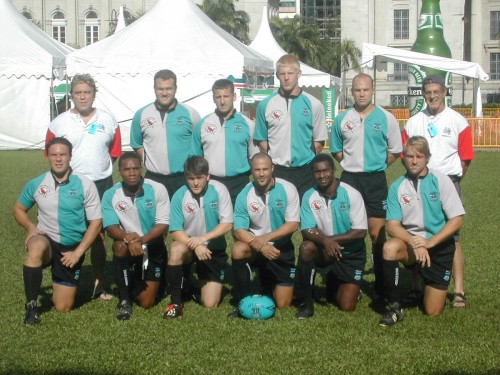
Atlantis/NOVA at 2004 SCC Sevens
Top - Bill Gardner, MC Laubscher, Rich Kindel, Mark Bokhoven,
Craig Hartley, Emil Signes
Bottom - Riaan Hamilton, Mike Harvey, Tyson Meek, Jason Raven,
Temesia Kaumaia, Al Lakomskis
Grizzlies in Singapore
Two years ago, Atlantis became the first team in
the 55-year history of the SCC 7s to participate. This
year there were two, as the Pacific Coast Grizzlies joined the
competition.
Americans
in Singapore
There’s 1-2 and there’s 1-2. This was the record of both American
teams in Singapore. Atlantis-NOVA, in a tough pool, was
the only one of the 3rd place teams to end up with a
positive point spread and went on to the Plate as the #13 seed.
If Atlantis-NOVA was in a
tough pool, then pity the poor Grizzlies who were in a pool
with the two eventual finalists, British Army and NZ Legends. The Grizzlies point spread didn’t
make the top 16 and they were relegated to the Bowl. The Bowl in Singapore,
however, has its benefits for American teams – a realistic
possibility to take home hardware. And
so the Grizzlies, as Atlantis had in 2002, went home with the
Bowl.
Itinerary
We arrived in Singapore
minutes before midnight
Tuesday after a 30-hour trip from home (for this East Coaster,
anyway). We trained twice, however,
Wednesday at Turf City,
formerly a horse race track and now a shopping center. Thursday
morning we scrimmaged the Durban Harlequins (and did quite
well). Thursday afternoon we had a
brief training session and then ran some individualized training
for members of the American
School rugby team.
In between sessions there was always time for food,
food, food, and Singapore
has some of the best food in the world. Lunches
were generally at one of the ubiquitous food courts (some
choices: Burmese, Malay, Northern Indian, Indian Muslim,
Nepalese, Japanese, Chinese, etc.) but Bill Gardner sponsored a
couple of dinners at really nice venues.
Singapore
From Westerners’ perspective, the history of Singapore
began in 1819 when Sir Stamford Raffles established a trading
station there; in 1824 Singapore was ceded “in perpetuity” to
the East India Company by the Sultan of Johore.
In 1942 Singapore
was occupied by Japan,
returning to the British fold after World War II.
It formed part of Malaysia
at this nation’s founding in 1961, but separated from Malaysia
and became a fully independent nation in 1965.
Singapore
lies right between Malaysia
and Indonesia,
but unlike both its Muslim neighbors, Singapore
is more than 75% ethnic Chinese and Buddhist.
The other 25% include significant Malay and Indian
communities.
Singapore
has a population of 3.3 million in an area of 264 square miles. It is considered one of the safest
countries in the world. It’s quite
prescriptive: chewing gum is illegal and caning is a legalized
form of punishment.
There are a lot of ethnic areas in Singapore, and
although we didn’t get to too many this year, in 2002 I was able
to visit Little India, which was in preparation for its Indian
New Year celebration (“Happy Deepavali” signs were everywhere). During that trip I ate at the Banana
Leaf Apolo restaurant and marveled at the Sri
Veeramakaliamman Temple.
Trinidad, Brazil,
Singapore
– what other sport unites so many geographically far-flung
places as seven-a-side rugby? Thanks
to yet another tournament that reaffirms sevens rugby as the
greatest sport ever!!